Summary
My Role
Designer Doing Research
Cross-Functional Team
1 Product Manager, 1 Tech Lead, 4 Engineers, 1 Accessibility Specialist
Target Users
HR Professionals of Contingent Program, mainly Program Specialist
Problem
Customers needed a comprehensive system to detect and manage duplicate candidate profiles, a product that existed only in the backend. The project was in extreme ambiguity, featuring a complex candidate pipeline with layered user scenarios and unclear product direction. My primary challenge was to translate abstract backend logic into a cohesive user experience while navigating the rigid constraints of a legacy system within the given timeframe.
Business Impacts
- Helped Product partners to scope and prioritize development work with greater confidence, advancing a 4-month-old initiative to execution within 6 weeks of joining;
- Accelerated the project timeline, cutting discovery time by 20% and kicking off development plan 3 months ahead of schedule;
- Established cross-functional team alignment on the development plan and empowered engineers to apply new technologies into solving for a greater user experience;
- Evolved the Design System with new design patterns and usages that fulfilled requirements in data hygiene, system explainability, and accessibilities.
Context
Managing duplicate candidate profiles is a recurring pain point in VMS platforms when multiple staffing agencies submit the same talent—not necessarily their faults! While Workday VNDLY could identify some of these redundancies, there was no way for end-users to view and take action on the duplication relationships, compromising the data integrity across the platform.
Business Case
As customers shifted hiring responsibilities to non-HR managers, the need for intuitive, self-service duplicate resolution became critical. The team prioritized an MVP focused on HR Pros to establish core system functionality first, ensuring a stable system before optimizing the experience for hiring managers in future iterations.
Main User Stories
As a program manager, I need the ability to review and resolve duplicate flags, so that I can maintain the data hygiene of the candidate records, reducing downstream impacts on the provisioning and timekeeping systems. (Prioritized)
As a staffing agent, I need to know if a candidate is already submitted or if the customer had bad experience with a candidate in the past, so that I can avoid submitting them to save resources and maintain good terms with my customers.
As a hiring manager, I need to understand the duplication relationships, so that I can manage the sourcing status and team headcounts accurately.
What does success look like?
- Candid: Explain to users why the system “thinks” these profiles are pointing toward the same person;
- Empowering: Provide users with guidance and tools to resolve the duplication, aligning with standard procedures;
- Flexible: Address various levels of ownership over candidate data and permission control of system records.
Execution
Identify the Right Problems to Solve
Main Challenge: The project was stuck in the Problem space for 4 months due to lacking contextual information about users and understanding of technical limitations.
I stepped in to help the team by gathering technical system knowledge from SMEs and synthesizing previous research to have enough information for a big picture to make decisions and move on.
Evidenced-Based Recommendations
- Address the legacy system frameworks & loose up the determinism of the existing algorithms.
- The existing automatic, hard-coded algorithms & flagging system couldn’t account for complicated use cases, combining with the lack of visibility & manual intervention into its “thinking process” has caused user frustration and distrust in the flag indicators on the UI.
- Introduce and embed the Duplication Review workflow into the candidate pipeline, that would compensate for the uncertainty of the new system while also meeting customer expectations.
- Customers didn’t need a perfectly accurate duplicate flag, but a candid & empowering user experience to manage all the duplication relationships, taking data hygiene & data privacy into account, from the early stages of the candidate pipeline.
Achievements
- Gained alignment with Product partners and moved the stalled project into the Design phase within just 6 weeks of joining;
- Recommended a technical approach that directly anticipated the company’s upcoming shift toward AI innovation, ensuring our solution was future-proofed for next year’s strategic growth initiatives.
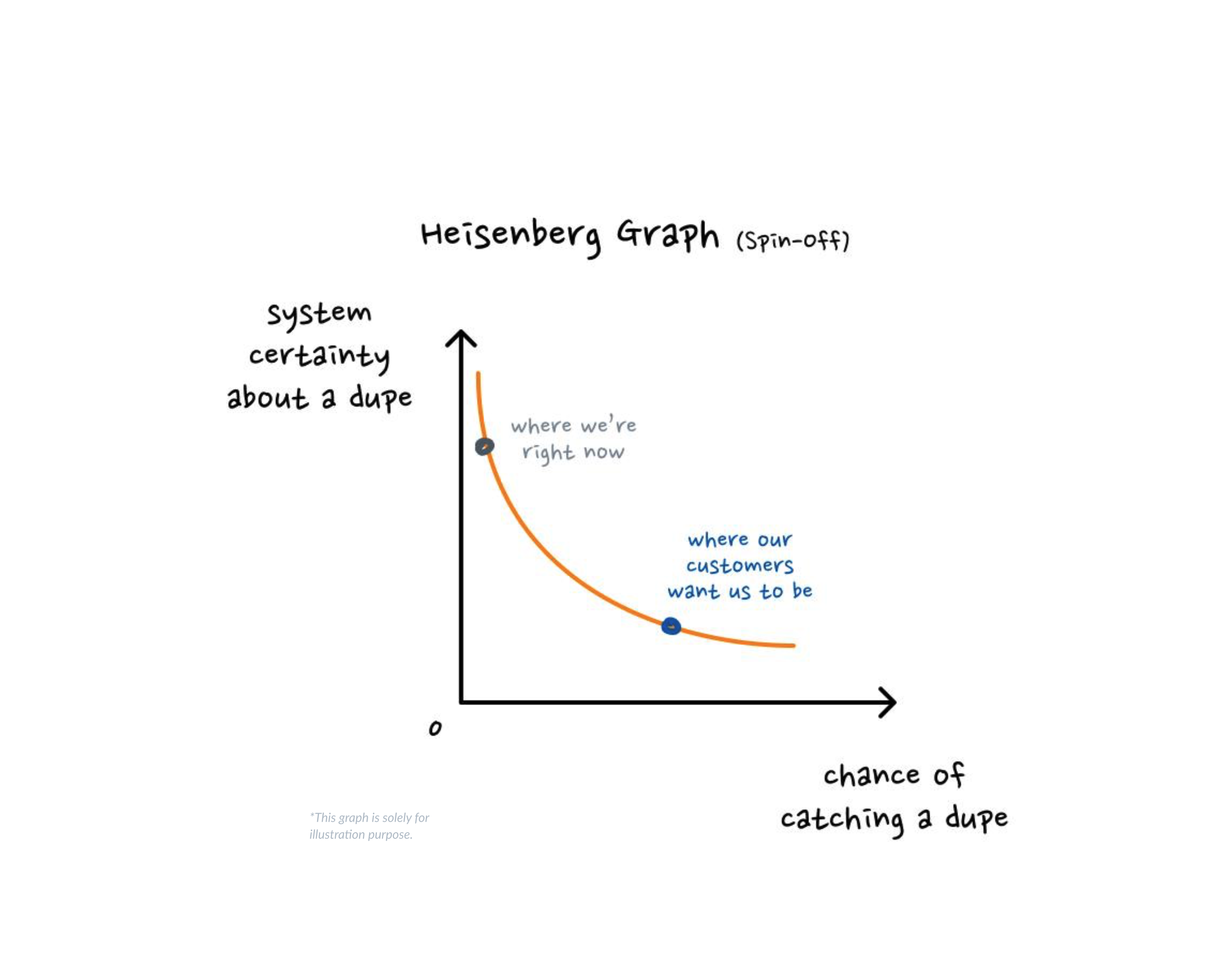
The Heisenberg Model.
inspired by principles of quantum uncertainty, this visual proposes to shift the system from a strictly deterministic to a more probabilistic one. when system certainty is tuned with deep intentions, the matching logic will become more fluid, increasing the coverage of identifying duplicate profiles.
What could have been better?
Given the extreme technical and systemic complexity of this project, I would have decoupled the user experience proposal from the system architecture. I could present the user-facing solutions solely to the PM to ensure alignment on customer expectations, while handling the technical proposal through a separate collaboration with the Tech Lead. This will ensure the content reaches the person most equipped to act on it.
Develop An Evidence-Based Strategy with Clear Prioritization
Main Challenges: A broad range of user journeys and unclear consensus on prioritization.
My Approach to Ambiguity
- Used lo-fi concepts to validate the Duplication Review workflow in various scenarios with 12 customers from different industries;
- Identified the highest-impact user touchpoints to focus effort on, setting the team on a single clear mission:
- Set concrete design requirements based on the more focused & validated direction:
- Candidly inform staffing agents about duplicate submissions, but not block them because some customers still want to keep the competitive pay rates;
- Candidly explain to program teams the duplication relationships when sourcing candidates. Further assist users to automatically reject other profiles when one is moved forward;
- Empower program managers to “disagree” with system’s flags and correct the duplication relationships.
- Hosted 2 brainstorm sessions with the UX team to tackle the requirements.
HMW empower users to resolve duplicate profiles with confidence from the early Apply and Sourcing stages?
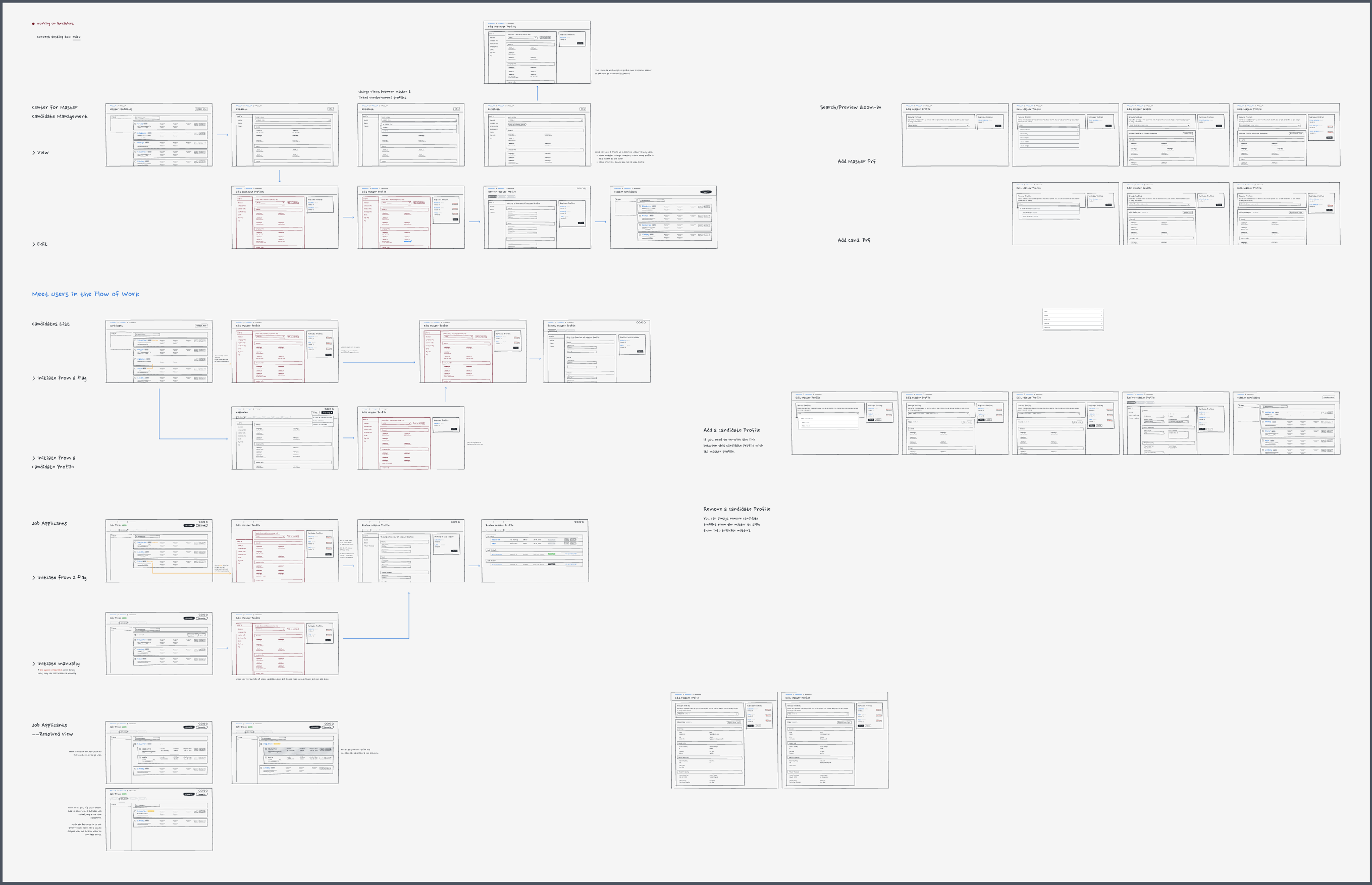
The Lo-Fi Sketches.
I adopt a "landscape design" approach to prioritization, using lo-fi concepts to map out the entire ecosystem—from backstage records management to end-user sourcing workflows. this high-level visualization moves the team to through granular distractions and reveals which touchpoints required deeper validation and which are ready to develop further.
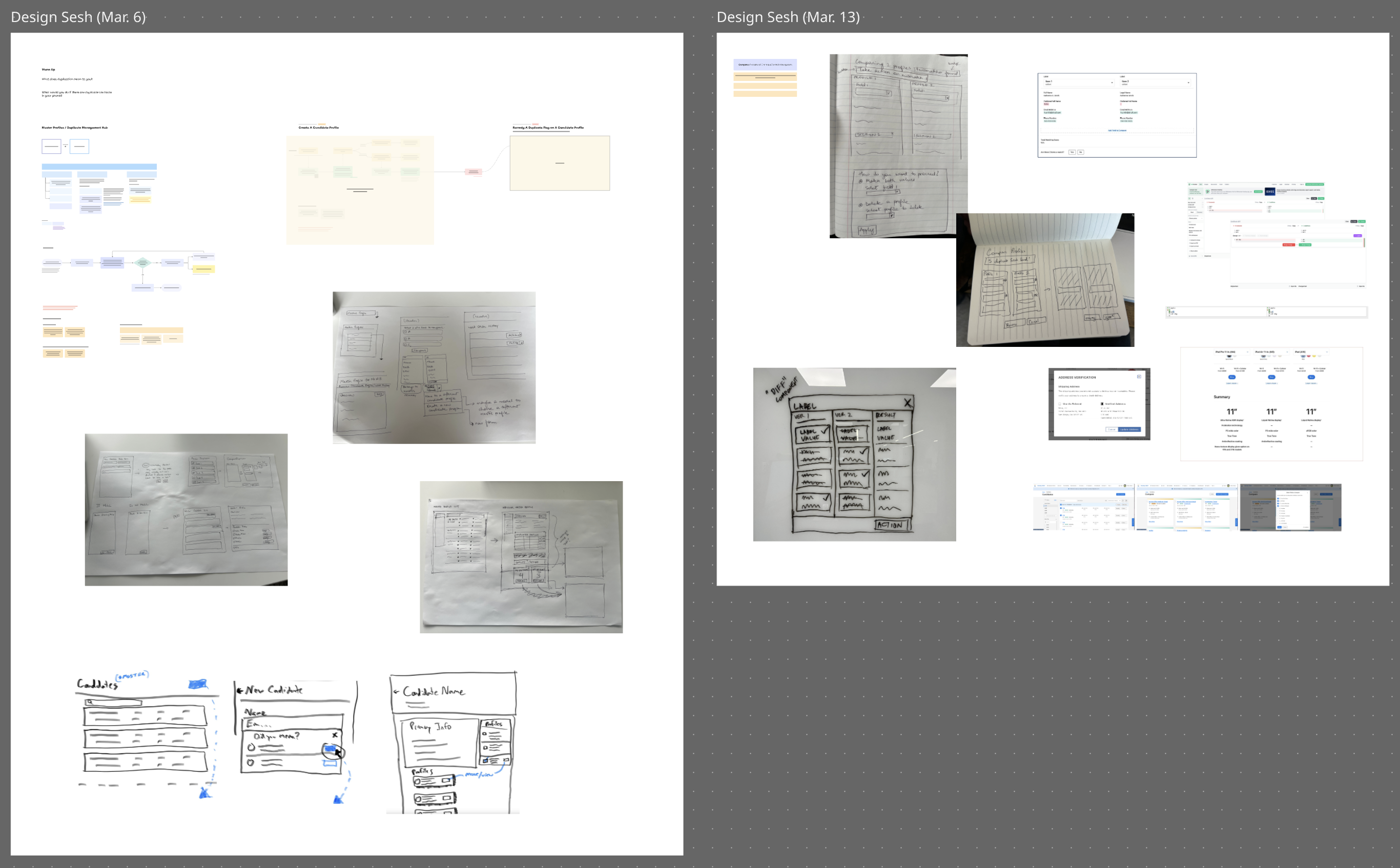
The Design Sessions.
by identifying common interaction patterns across diverse user journeys, I abstract complex product requirements into scalable design goals. then facilitate cross-area design workshops to develop reusable components that solve immediate needs while maintaining overarching design standards.
Concept Evaluation
- Leveraged the rapid research approach, abstracting the ideas into design concepts to run validation, instead of A/B testing individual ideas;
- Gathered sentiments on business impacts of the solutions from 5 customers and 3 program partners;
- Conducted testing with 4 users to assess usability of the concepts.
This focused approach cut down 50% time & resources spent on evaluation while ensuring the design usable and moving the project forward.
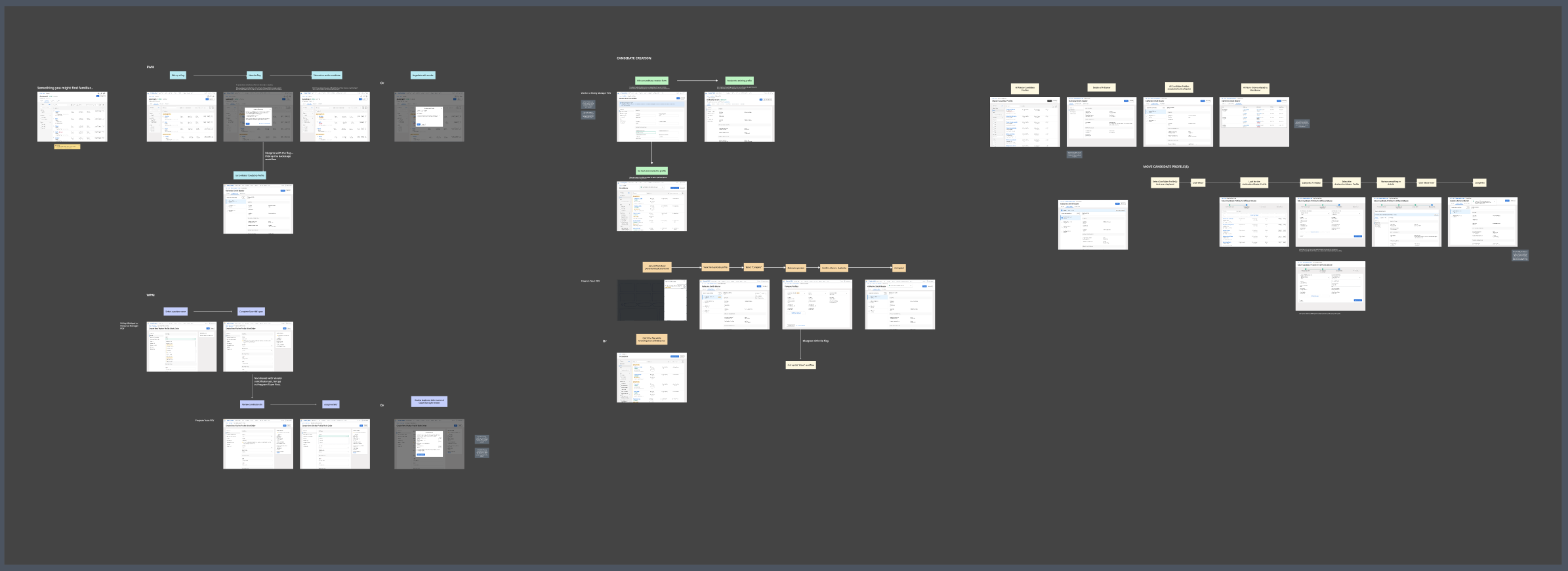
The Mid-Fi Flow.
after distilling my initial concepts into refined mid-fidelity designs, I team up with my PM to walk our partner customers through the total experience. these designs are conversation starter to get a "pulse check" on our direction. it's not about getting the final Approved stamp but gathering directional feedback needed to prioritize the right concepts and move forward with confidence.
The UT.
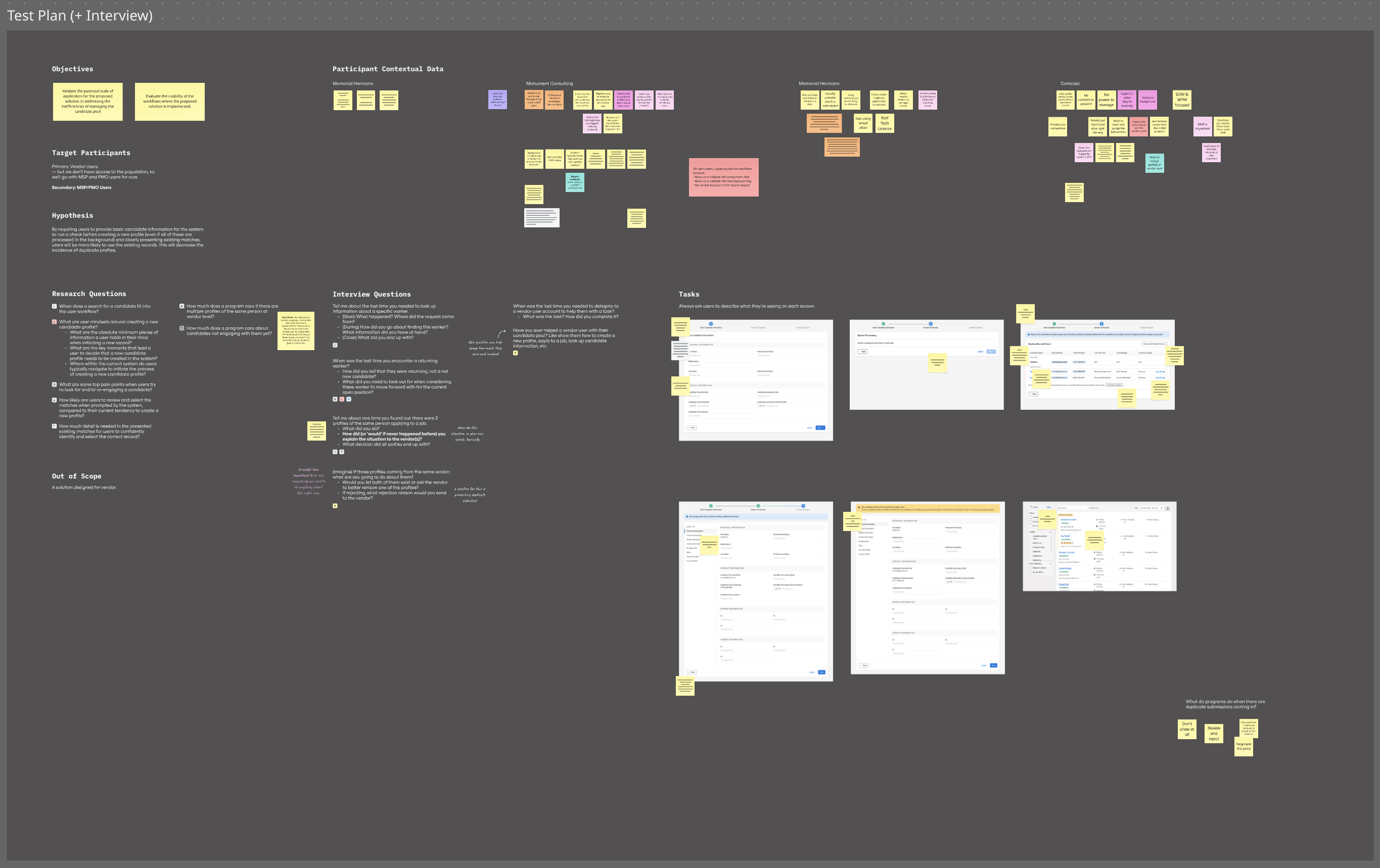
to validate the new components, I develop a specialized "patchwork" flow that allowed me to evaluate the usability of these patterns within real-world narratives. with deep research on the participants prior to each session, the challenge of navigating this prototype is transformed into an opportunity to establish a connection with the customers & uncover critical insights regarding user context and edge cases.
Impacts
- Created a versatile system that solved the immediate problem while also serving as a blueprint for the market trend toward self-service, decentralized hiring practices;
- Developed comprehensive workflows that were recognized by stakeholders as a friendly solution for non-HR users in different sourcing models;
- Navigated deep ambiguity with an evidence-based approach, provided the clarity needed to unblock the project, moving from concepts to designs in just 8 weeks;
- Gave Product partners confidence to greenlight the development roadmap 3 months ahead of the original schedule.
What could have been better
I’ve found lo-fi wireframes as a strategic tool for early scoping. Visualizing core requirements at lo-fi allows the team to validate and prioritize features before any hi-fi design begins. This ensures development effort to be spent on proven functionality, allowing for a more intentional and efficient use of resources from the start.
However, I learned that lo-fi wireframes require clear framing to be effective. In the future, I would explicitly state the goals of these artifacts to keep Product partners focused on core system functionality rather than trivial visual details, ensuring the team remains aligned on the strategic objectives.
Establish Alignment with Engineers Through Collaborative Workshop
Goal: to bridge the North Star experience with current system limitations.
I led a day-long cross-functional workshop to assess feasibility of the design approach and establish a shared vision among the Engineering team:
HMW evolve the duplicate flagging logic into a context-aware system, integrated into the candidate pipeline, leveraging diverse data variables and parameters?
Impacts
- Sparked early innovations for a probabilistic approach to duplication detection & optimized performance, which was well beyond the initial expectation!
- Opened a discussion about where "the magic" needed to happen, balancing user needs and technical feasibility, leading to a more focused allocation of development effort.
The session proved that a strategic, evidence-based design vision can champion architectural change. The team’s enthusiasm for evolving legacy systems validated the technical recommendation I’d made earlier. I effectively used design to align engineering's capabilities with a more innovative product roadmap.
The Workshop.
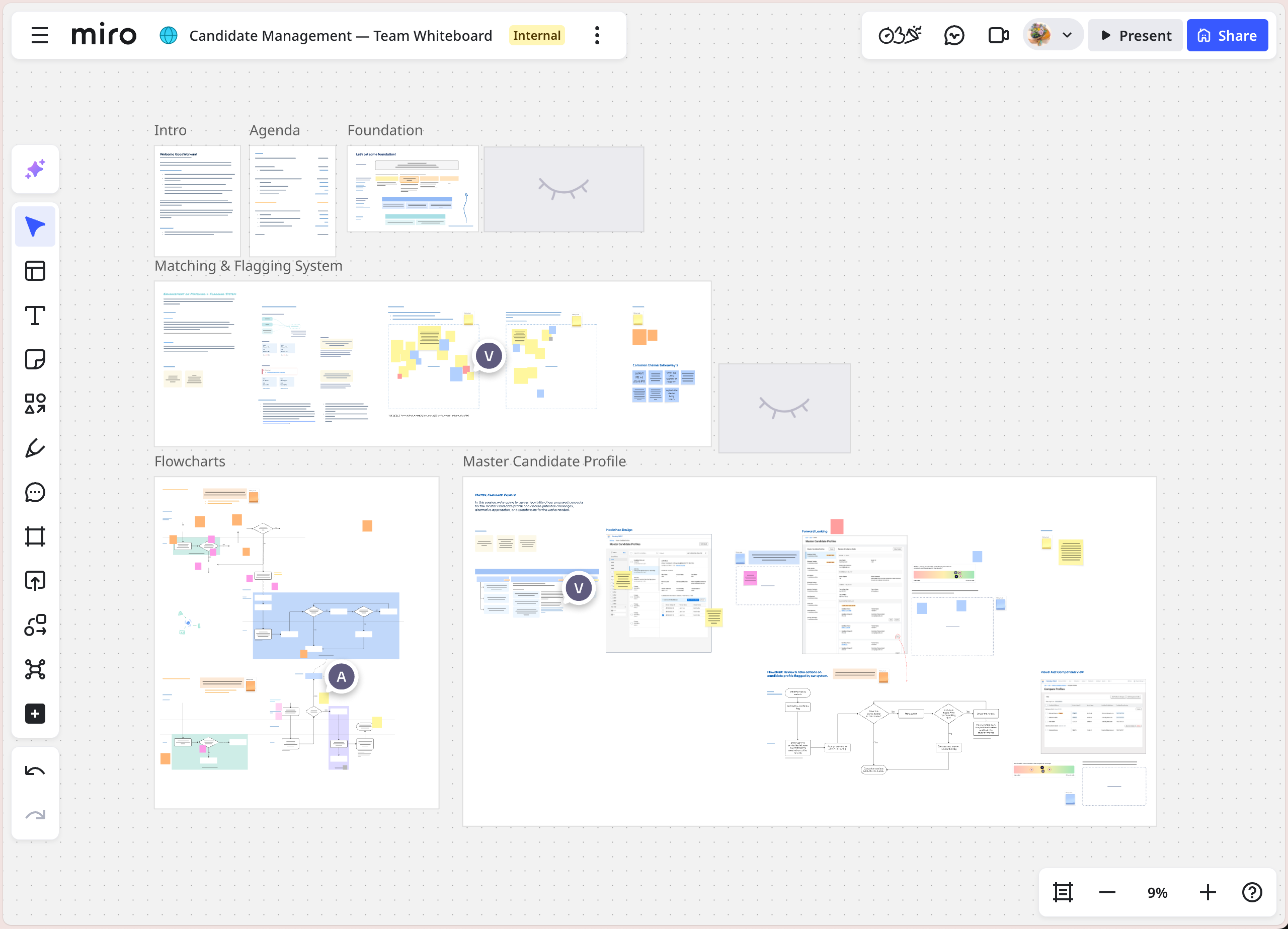
moving away from “fixing” the existing system, my primary goal for the workshops is to encourage the team to think about new approaches to meet user needs. before facilitating, I audit the existing documentation and technical constraints to align myself with engineering language. I convert the user journeys into a functional flowchart with clear trigger events and decision trees to map background tasks against user touchpoints. the workshop is centered on three outputs: a new probabilistic algorithm, a technical review of the flowchart, and a feasibility assessment.
This [the proposed experience] is not 2 lines of code, Emi! But it’s not impossible.
(Principle, System Architect)
Every question I had, got answered right in the next activity!
(Sr. SWE)
It was really good planning.
(Sr. SWE)
What could have been better
Technical alignment should be a continuous dialogue rather than a single formal session. In the future, I would invite engineers to the design process more often, facilitating a constant "reality check." Moving technical discussions upstream ensures that the design evolves along with technical feasibility.
Furthermore, I now view technical constraints as essential inputs for system-level scoping, treating engineering feedback as a strategic guide. This partnership allows us to define systemic solutions together, ensuring the final product is both ambitious and implementable.
Deliver Validated Excellence Within A Tight Timeline
Goals: A unified view of duplication relationships + An intuitive path for users to compare the data and correct the relationships.
Main challenge: The product was only a technical framework. User-facing experience didn’t exist.
Results
- By establishing a North Star experience from day one, I was able to accelerate the design phase, creating a necessary space for usability testing and accessibility review.
- Ensured the final design was delivered on the promised timeline without compromising quality, achieving 100% task completion rate and meeting WCAG 2.1 compliance.
I led the definition of this product’s interaction and visual by leveraging and evolving the current design system. By mapping core functionalities to existing patterns, I built a cohesive interface from scratch while maintaining the consistency across the platform, necessary for user trust and adoption upon roll-out.
A couple of main design components:
- Leveraged a split layout to mimic a directory structure for grouping duplicate profiles and managing duplication relationships;
- Evolved the standard table component into a Comparison View, providing HR Pros with the data-dense, scalable interface they already trust.
A (Not) Fun Challenge: Midway through the design phase, the project timeline was unexpectedly reduced by 3 weeks. However, with a clear experience strategy and reusable component framework from the start, I was able to absorb this change without sacrificing the design quality or cutting the crucial validation.
Kudos from stakeholders & users:
I love, love that you can move the profiles around and add different fields to the comparison view. This is exactly what we’re looking for.
(a Telecomm customer, reviewing the overall approach)
I like the way your design guides me through. And shows me the possibilities. I look forward to when this gets rolled out!
(a user from Healthcare industry, participating in a usability test session)
Accessibility Review
It revealed that my initial design unintentionally excluded certain users. Specifically, the drag-and-drop mechanism was inaccessible via keyboard, and the nested table architecture in the Comparison View failed to provide a clear, logical hierarchy for screen reader users. Actions taken:
- Deprioritized specific UI elements in favor of the core user goals: effective interactions on the folder and clear data presentation for comparing.
- Partnered with the accessibility specialist to swap out problematic elements for more inclusive solutions, ensuring the final design as accessible as it was functional.
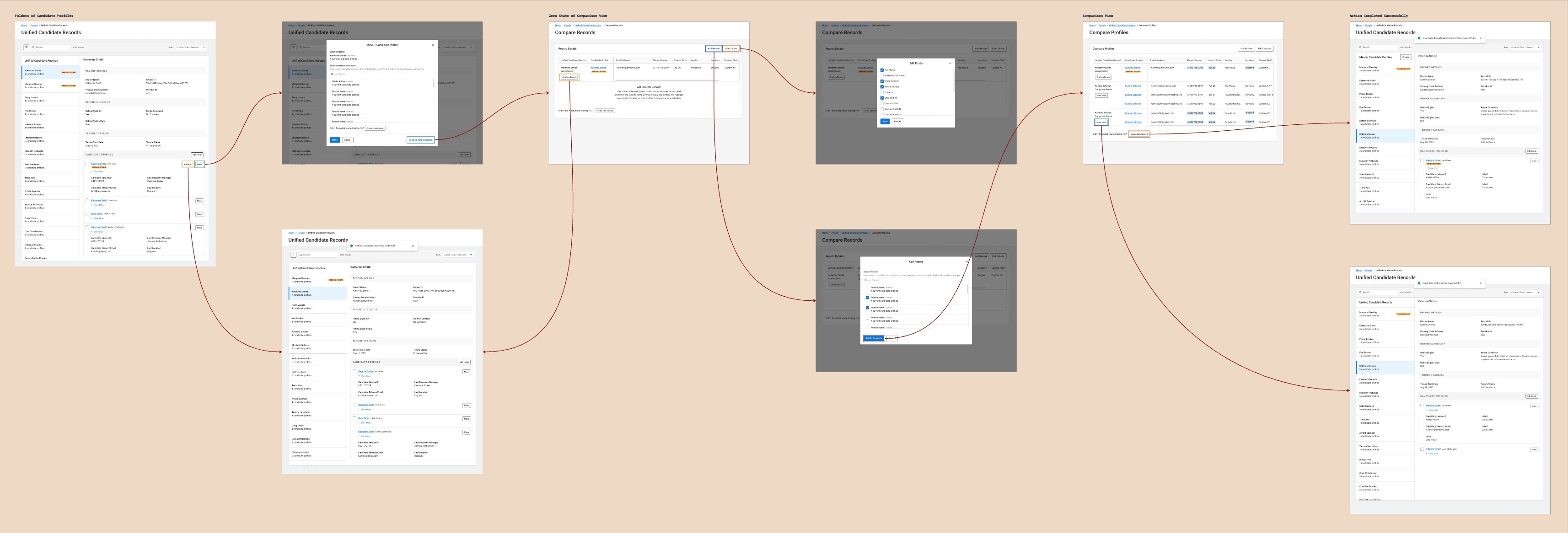
The mock-up I’m showing here is for the scenario when a program manager disagrees with the system’s flagging & grouping. So they move the flagged profile to a different “folder.”
The Flow.
referencing the "keyframing" method in animation production, I first establish the primary requirements as keyframes, then filled the workflow with the necessary "in-betweens." these transitional states include: a selection modal pre-comparison view, zero-states, and success screens. the finalized flow enables program specialists to resolve duplicate flags and move profiles across folders. once a choice is confirmed, users receive system feedback and see records updated.
The Folder.
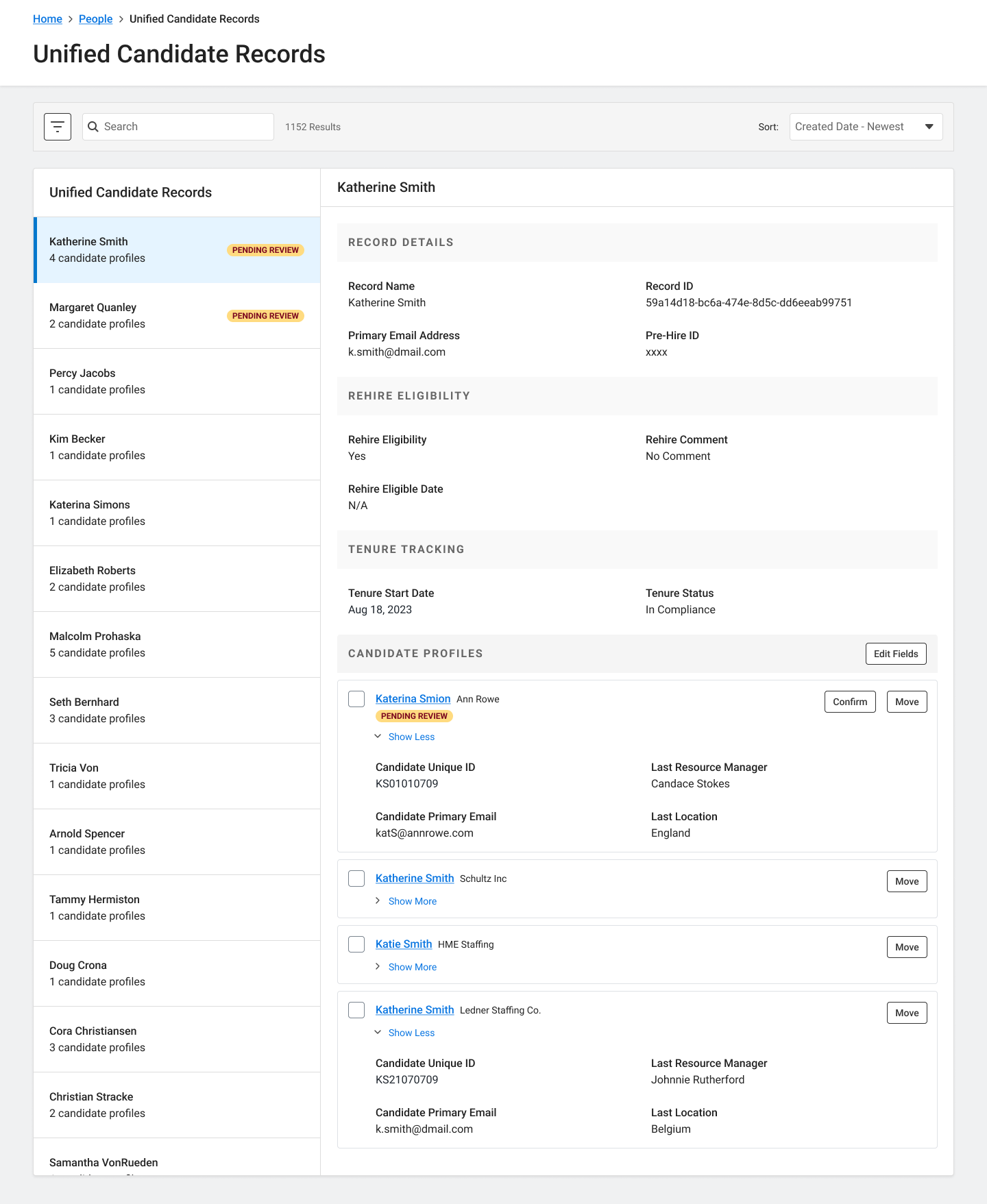
the interface features a split layout with a "folder directory" on the left and folder details with "child-profiles" on the right. a child-profile may have the “Pending Review” badge to indicate new duplicate profiles found by the system, awaiting for users to confirm. this version removes the drag-and-drop interaction and enhances the affordances to comply with accessibility requirements. the Candidate Profile section has an updated visual hierarchy, separating names from data attributes to strengthen the parents-children relationship of objects.
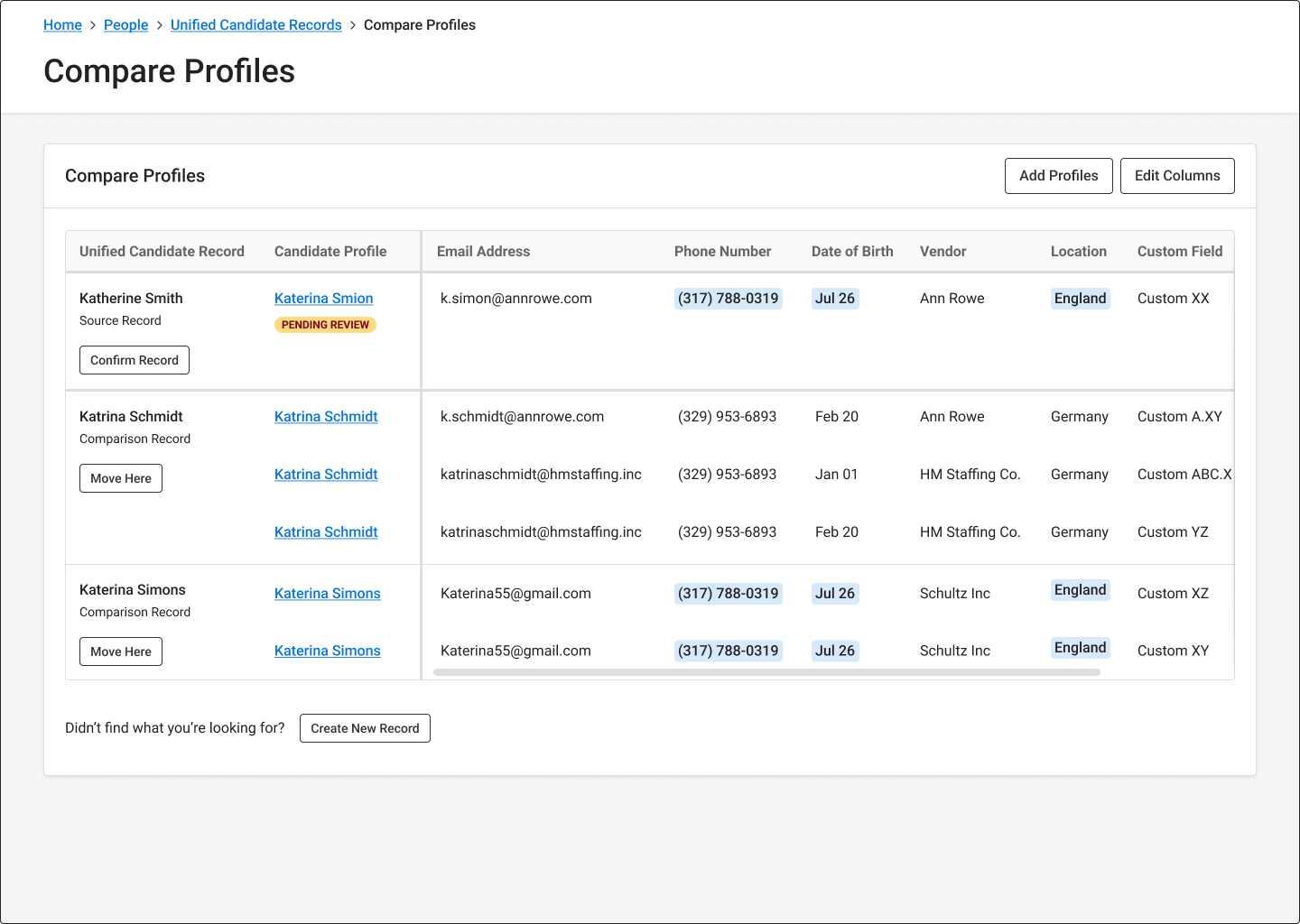
The Comparison Table.
previously a nested table, this version uses a merged-cell structure and clear constraints on sticky columns & rows to enhance accessibility. the system runs checks and highlights matched information across profiles. this helps users quickly recognize the similarities among the profiles being compared. the interface allows users to modify data columns and add more candidate profiles to make comparisons.
What could have been better?
I’ve learned that collaboration at the execution phase requires clear ownership to stay on track. I’m now practicing to be more proactive in restating the agreed-upon priorities and navigating accountability throughout the process. This is to ensure remaining focused on high quality of the deliverables within the tight timeline.