Summary
My Role
Experience Strategist & Design Lead
Cross-Functional Team
1 Product Lead, 2 Architects, 4 Engineers, 2 Automation Engineer, 1 QA
Target Users
- HR Professional (Staffing Specialist & Program Specialist)
- Finance Professional (Hiring Manager & Program Specialist)
- Configurator (System Admin, Solution Architect, Functional Consultant)
Problem
Proving how a calculation engine gets to its numbers is crucial to build the trust needed for product adoption. The challenge was to translate these complex logics, driven by various rule settings and security layers across NA, EMEA, and APAC, into a simple, user-friendly format. My goal was to create a consistent explainability pattern to clarify the math and reasonings behind every calculation, envisioned to deliver an assistive, insightful experience that helps users forecast budgets and make more equitable hiring decisions.
Business Impacts
- Enabled expansion into the €5B German market by providing greater transparency and removing feature restrictions through a well-thought-out experience strategy;
- Streamlined the FY27 Roadmap by identifying critical decision points through rapid research; provided the Product team with the clarity needed to move through uncertainty and accelerate product launch by 2 months;
- Transformed a skeptical culture into a "shared ownership" model, incorporating the team’s inputs into the experience strategy to ensure technical feasibility was baked into the vision from day one, eliminating redesign loops and creating a seamless handoff that saved enough capacity to ship "lovable" features beyond the initial MVP scope
Recognitions
Emi has been a great collaborator and an amazing teammate for all the right reasons! It's been eye opening for me to see how a great partnership between UX and Product impacts the project. I wanted to say, a big BIG thank you for being such an amazing partner in crime throughout this whole journey of finding the best solution for our German & EMEA-based Customers.
(Product Lead)
She's been with the team for a short time (3 months) but heavily involved in [a new global project] along with the enhancements to expanding the [new features] in Calc Engine. I really appreciate her attention to details and the way she explains her thinking process. She's also great about taking feedback from the team to update her design directions.
(Engineering Manager)
Context
In 2023, KatThree valued the German contingent labor market at 5 billion Euros. For Workday VNDLY, a workforce management platform with global ambitions, that number represents both an opportunity and an obligation.
Business Case
Reported in Q2 FY26, compliance with German labor law had become the #2 reason for lost sales. It was critical to the company’s growth, especially since over 23% of our current customers run programs in Western Europe.
Recognizing the company’s FY27 Growth Priority was EMEA expansion, the team needed to address this gap by solving a foundational problem: automating global rate calculations and enabling customers to comply with worker pay regulations early in the contingent sourcing flow.
Main User Stories
As a Program Manager, I need oversight of the uplift schedule and configuration controls so that I can ensure compliance with labor regulations while staying aligned with my organization's procedures.
As a Hiring Manager, I need to understand the impact of the pay uplift on my project budget before a work order goes live so that I can make informed resourcing decisions.
As a Supplier, I need visibility into when and how the CBA uplift affects the worker's pay rate so that I can prepare accurate billing and set the right expectations with my contractors.
What does success look like?
- Candid: Explain to users how worker’s pay rate was calculated and scheduled, and its impact on customer budget;
- Empowering: Provide users with guidance and tools to adjust pay amount when needed, in alignment with different industry standards & customers’ procedures;
- Scaleable: Address use cases varied by country; ensure the approach applicable for various rate components that made up the final invoice.
Execution
Co-Own the Problem Space with Cross-Functional Partners
The initiative had been hanging around for 8 months, passing through the hands of 3 PMs without involvement of any Designer as a thought partner, while development was set to kick off in one month.
Key Challenges:
- High complexity, high risk problem space spanning regulatory requirements, multi-party workflows, and business budget implications;
- No coherent vision for the user experience in a market the team had never designed for;
- Unknown infrastructure readiness to support the required concept and desired experience;
- Structural alignment across disciplines urgently needed.
My Approach to Chaos
Rather than jumping into solutions, I oriented the team around 3 research questions:
- What are the requirements in this labor market?
- How might the end-to-end experience look?
- What's missing from the current infrastructure? (to support the required concept and desired user experience)
These questions became a stabilizing frame that gave the team a shared direction without prematurely narrowing the solution space.
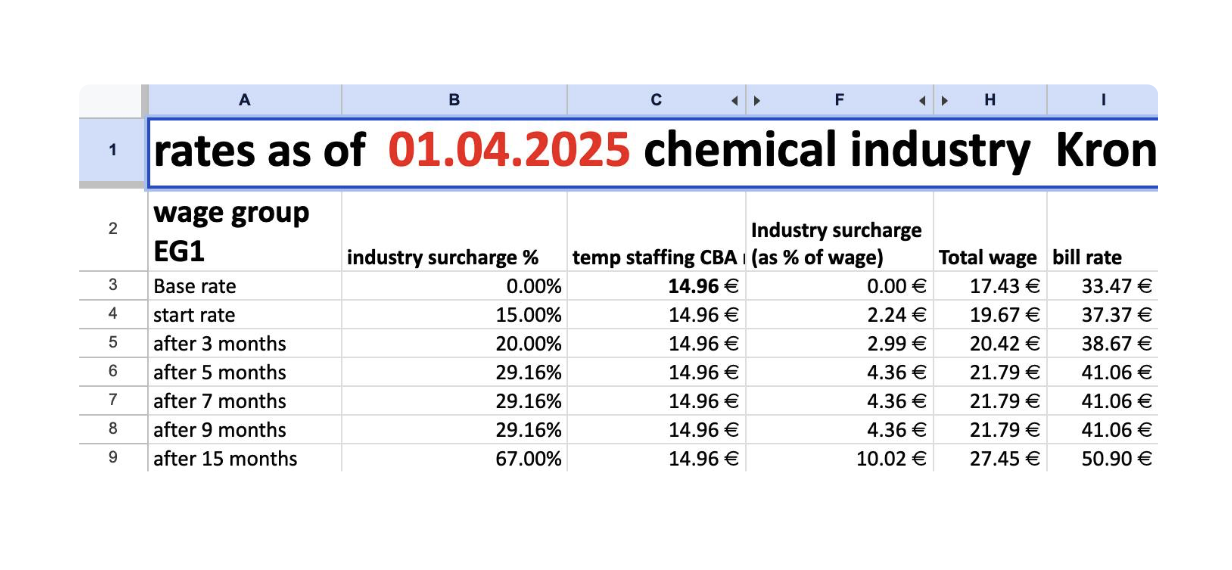
The Industry Surcharge.
in Germany, industry surcharges (branchenzuschläge) for temporary or agency workers (zeitarbeit) are not set by a single federal law or static statutory rate, but are negotiated via collective agreements (tarifverträge) between trade unions and employer federations. surcharge is varied by length of worker's engagement with the customer. users (the employers) currently track these rates in spreadsheet, then manually load the data into VNDLY. this practice risks human errors, operational efficiency, and permission controls (lack of visibility into who is viewing & maintaining the rates).
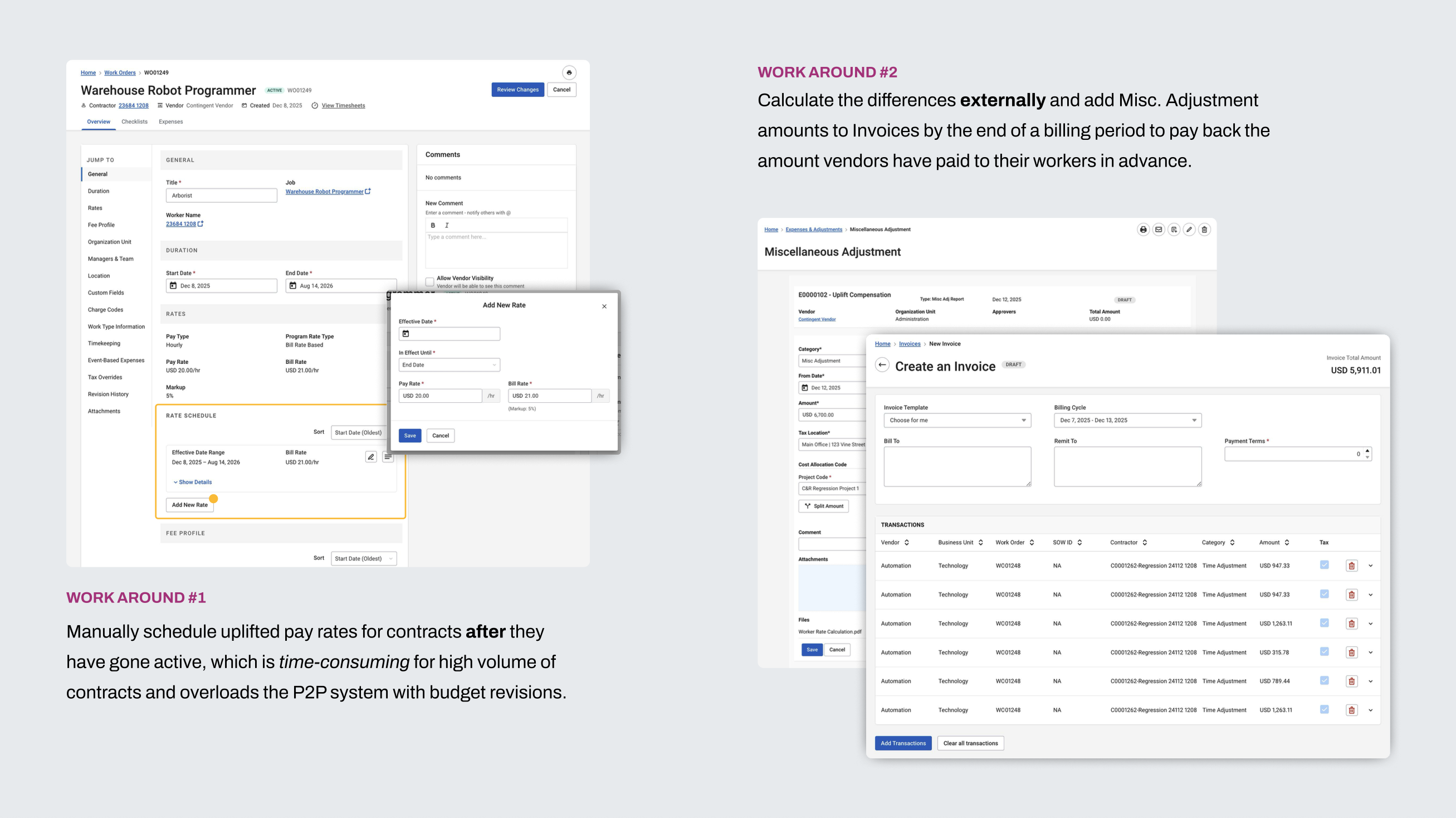
The Workarounds.
research has revealed two paths that contigent programs typically take as workaround: (1) bulk-update pay rates on active work orders and (2) add misc. adjustment to final invoice. both paths share the same goal: to ensure that the company pays back the uplifted amounts owned to the suppliers. and they also share the same challenge: manual effort, which is high-risk & time-consuming for 100x contracts.
Execution Tactic: No Hand-Off Model, Only Genuine Co-Ownership
From the first customer interview through every team session, the PM ensured all three roles (PM, UX, and Architect) were always in the same room. We interviewed, debriefed, synthesized, and ideated together.
My contributions as the UX partner:
- Mapped current user workflows and surfaced pain points by asking questions grounded in business process (BP) that neither the PM nor the Architect were positioned to uncover;
- Gave the team a shared visual language for how the system should behave by building user-system interaction models for both backstage (admin settings & configurations) and front-stage (end-user journeys);
- Made the team's ideas tangible by developing wireframes based on agreed interaction models and conducted early evaluation with customers directly.
Kudos:
Emi is very quick to absorb all the information from the different stakeholders and proposed multiple design flows for rather complex parts of the application. Her options comes along with a thoughtful analysis of the pros and cons, while remaining consistently open to feedback or pivoting the approach entirely. It was one of the most engaging and collaborative projects I have been a part of in 2025.
(Principal Architect)
This is absolutely going on the right direction, absolutely what we need! We have to communicate this to our sales team and architects. This will really be a game changer. You will definitely step into the EMEA market, especially when it comes to blue-collar.
(MSP Partner, German)
I like seeing the contractor tenure status because that is important to understand how we're getting those bill rate values.
(Enterprise Architect)
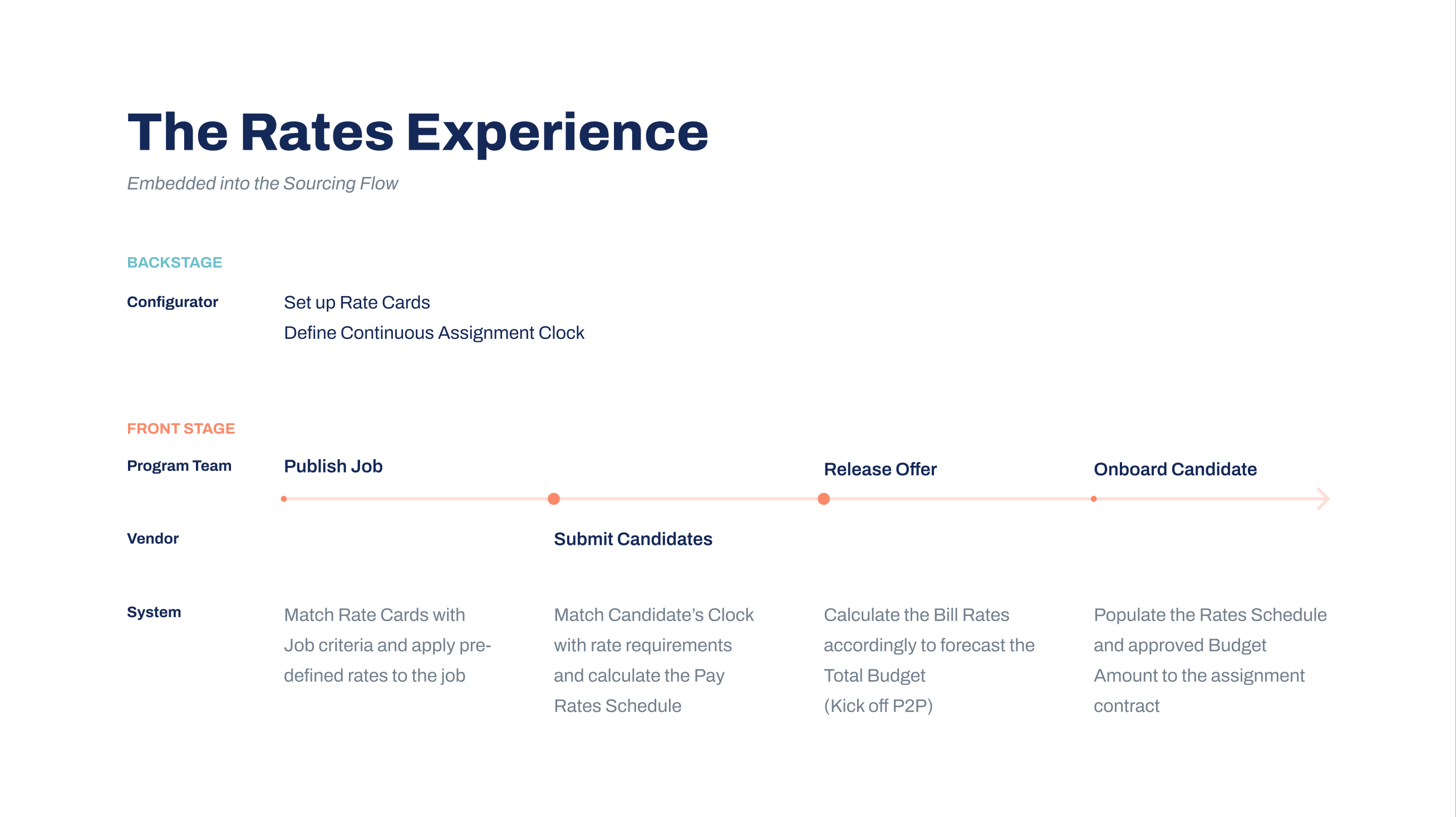
The Blueprint.
a cross-functional alignment tool. illustrates new product requirements and maps trigger events against expected system behaviors across each stage. also lays out specific impacts on all three user types to help teams prioritize development items. for example, while Managers thrive on progressive disclosure throughout the hiring journey, System Configurators care far more about settings logic than interface aesthetics.
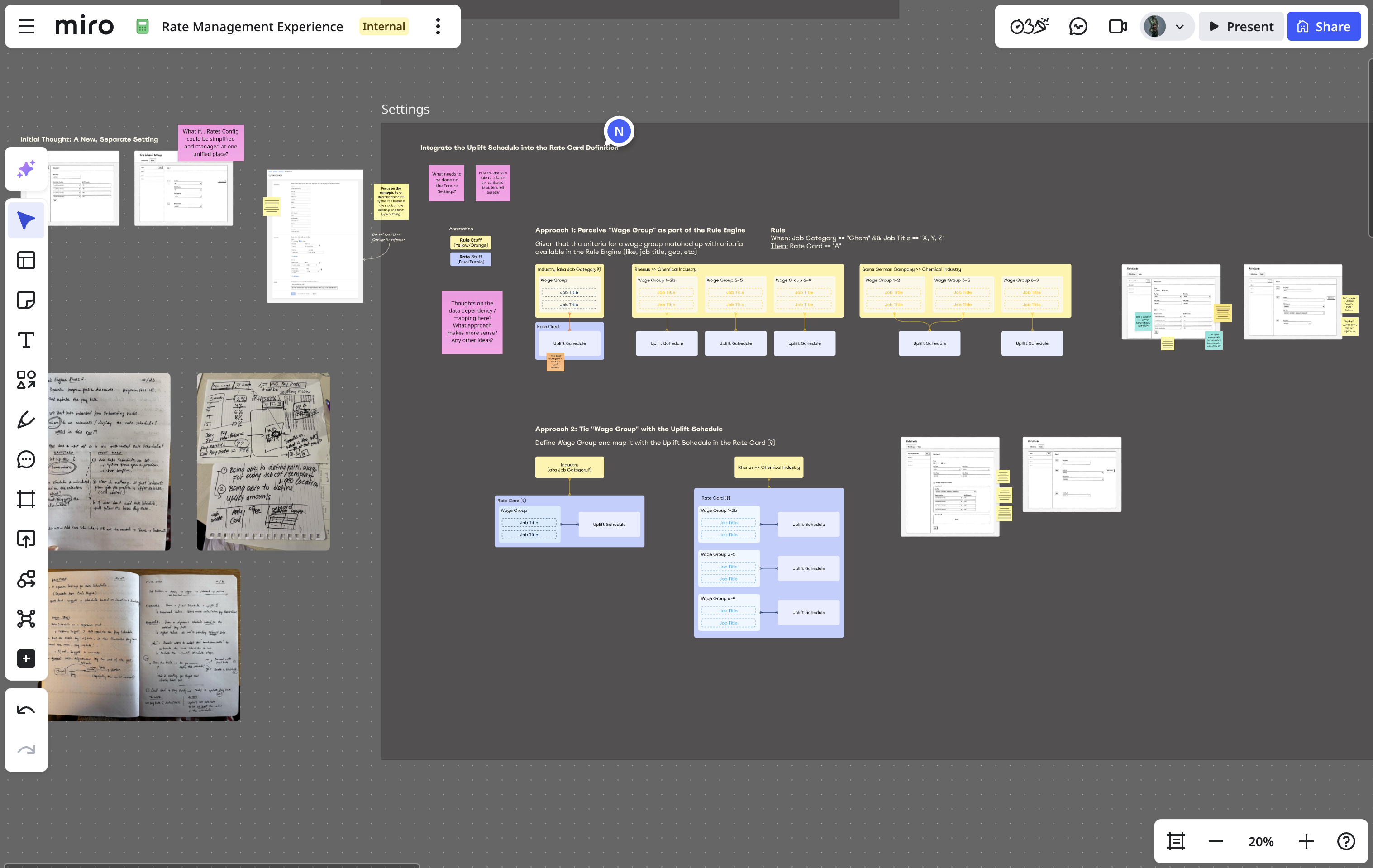
The Workshops.
early Product's sketches translated into technical system requirements and facilitated three cross-functional sessions with engineering and systems architects. the team evaluated two proposed design directions, while I noted the trade-offs and decision logics along the way. letting go of the non-viable option early means we could pivot without friction. this aligns Engineering on their technical spikes while giving myself a crystal-clear design problem to solve.
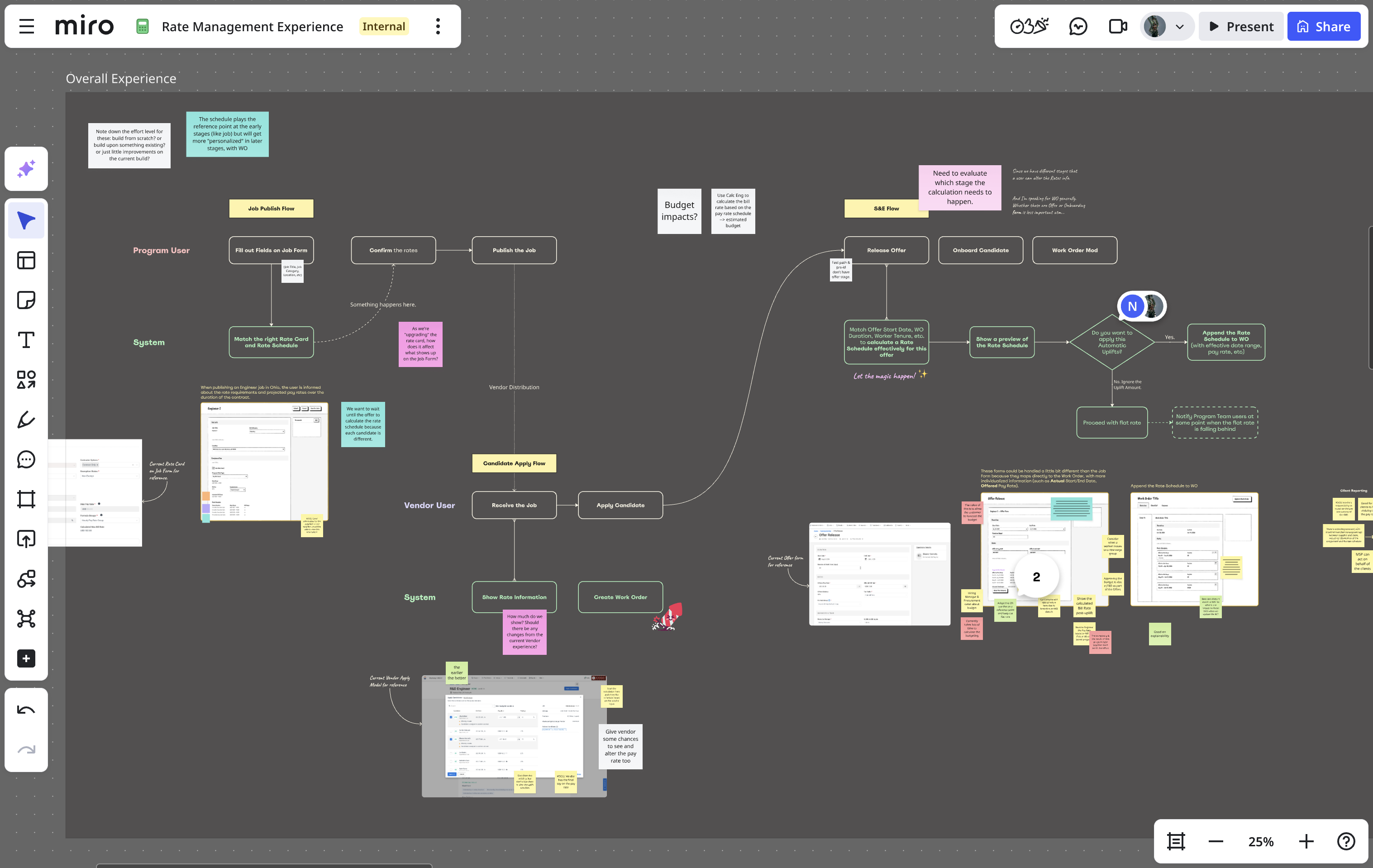
The Concepts.
all about the human side of the experience. instead of sinking time into polished mockups, I used high-level diagrams and quick sketches to bring customers right into the Design & Development process with us. walking through the workflow together helped us spot exciting growth opportunities, flag risks early, and gather the real-world insights needed to shape a smarter roadmap.
Design Evaluative Research with Intentional Use of AI Tools
Goal: Assess architectural risks and validate assumptions for a novel, cross-pillar concept.
Key Challenges:
- Cross-Pillar Alignment: 7 stakeholders across 4 major product areas needed alignment on the feature impacts, edge cases, and risk mitigations;
- Engineering Clarity: Our engineers needed early clarity on code dependencies outside their expertise to investigate and estimate effort accurately;
- Prototype Bottlenecks: A spaghetti Figma prototype couldn’t simulate the right context, interaction, and friction reduction needed for natural user behaviors in testing.
Approach to Research Design
- Identified targeted test criteria by translating Product risks into actionable design problems.
- Example 1: “HMW fit the Wage Group concept into the existing Rate Card system to avoid introducing new architectural complexity?”
- Example 2: “HMW insert the Rate Schedule Preview into the Supplier user journey without forcing a 3-month system re-architecture?”
- Analyzed uncertainties and isolated discrete problems into layout construction, information hierarchy, and user comprehension of rate adjustments.
- Built intentional, utility-focused prototypes with Lovable, anchoring user & stakeholder feedback on core interactions & functionalities rather than pixel perfection.
- Prioritized insightful rapid research; avoided over-engineering early iterations.
Approach to AI Tooling
- Curated test strategies and owned the research intent behind each scenario; then used Claude to generate the scenario content itself, keeping the evaluation sharp and the setup unbiased;
- Used Mockaroo to design structured datasets with precise data types & custom logics based on defined test scenarios, simulating enterprise states;
- Built interactive prototypes in Lovable, consuming the Mockaroo data & serving the test strategy; participants could actually experience real interactions, system feedback, and no hiccups with static screens;
- Applied linguistics and computational cognition to prompt architecture with precise framing, deliberate sequencing, consistent output quality across every tool in the stack
Learnings
The Beauty of Simplicity. Simplicity means giving users only what they need, when they need it; not a parade of "convenient" features that create noise. Getting there requires deep ecosystem understanding of the users, the market, and the software. By making deliberate decisions about what runs quietly in the background vs. what genuinely deserves UI space, I realized we don't have to mirror messy system workflows. We just have to deliver what matters, right when it matters.
Trust My UX Foundation & Practices. Working with visionary and strong cross-functional partners has turned design from a second-guessing exercise to an empowering collaboration. When I ground my work in core UX principles, I stop doubting myself and start trusting my own judgment.
Always Own the Intent. AI, qual or quant methods, design mockups, and prototypes are merely execution tools. The real impact starts with defining the problem (often organizational rather than user-facing), grounding my approach in cognitive science, and wielding methods strategically to bring stakeholders along.
Lead Like a Hen. Good leadership filters the noise and translates ambiguous asks into structured problems, so the team can stay focused and feel safe to explore & innovate. It takes research, forward-looking vision, and genuine respect for the team's input. But underneath all of it is one simple idea: Just be there for the team.
Special thanks to my PM for being a big sister/mentor/leader and my Architect for challenging my naïveté and giving the much needed critique for my career growth (*^_^*)