Summary
My Role
Researcher, Curator, Presenter
With Special Support from…
UX Leadership, a Product Manager, an Engineer Manager, and many more engineers
Target Audience
The VNDLY Product, Design, & Engineering Organization
Business Impacts
- Reframed the hype over AI as an opportunity to address underlying platform problems that fundamentally impacted user productivity;
- Drove the organization’s Strategic Growth Initiative to set Tasks System Intelligence as a priority for investment in the core platform and AI-powered innovations;
- Provided the cross-functional teams with a shared language to give constructive feedback on design problems and communicate design decisions, fostering a collaborative, shared-ownership culture;
- Increased the quality bar of the UX team’s deliverables in the era of AI, by shifting the focus to information architecture and interaction design.
Recognition
Emi's personal work product is typically spot on and well thought through. She turns things around quickly, and is quick to hop into the application and research any issue. We were going through some branding updates for the VNDLY application this year, and our GM mentioned if we were surfacing the right problems on our homepage. Emi worked to pull together a broad analysis focused on the gaps in the current experience as well as expectations from our users on their JTBDs. Around this same time, Emi led a Lunch & Learn session for the organization on Semantic Interaction Design.
I mention these two items as not only did she apply this into her work, she took it a step further to evangelize the practice to the whole organization.
(Head of Product, VP)
Context
Organizational Challenge: Lacked a unified language for design, resulting in a transactional culture where UX deliverables were treated as "work orders" rather than strategic solutions. This led to:
- Subjective Feedback: Stakeholders struggled to give constructive feedback based on the logic of user needs, focusing on aesthetics instead.
- Communication Gaps: Non-designers found it difficult to comprehend complicated systemic issues, leading to friction in alignment and decision-making.
- Siloed Execution: Engineering and Design operated on different mental models, blocking collaboration and slowing down development cycles.
Recognizing this as an organization-wide alignment problem, I utilized my transitions across various teams as a "research laboratory." I mostly researched collaboration methods and human cognitions in my own time, then observed diverse team dynamics to identify common friction points. Through studies and experiments, I found the Object–Action framework to be the most effective.
My goal: to introduce the Object-Action Framework, a methodology that aligns design architecture with engineering logic, to shift the conversation from "how it looks" to "how the system functions."
My Action Plan
- Applied the framework to solve a platform puzzle (initially raised by our GM) and present the POV to the Product leadership;
- Presented at the Lunch & Learn series, targeting the content to engineers, architects, and designers;
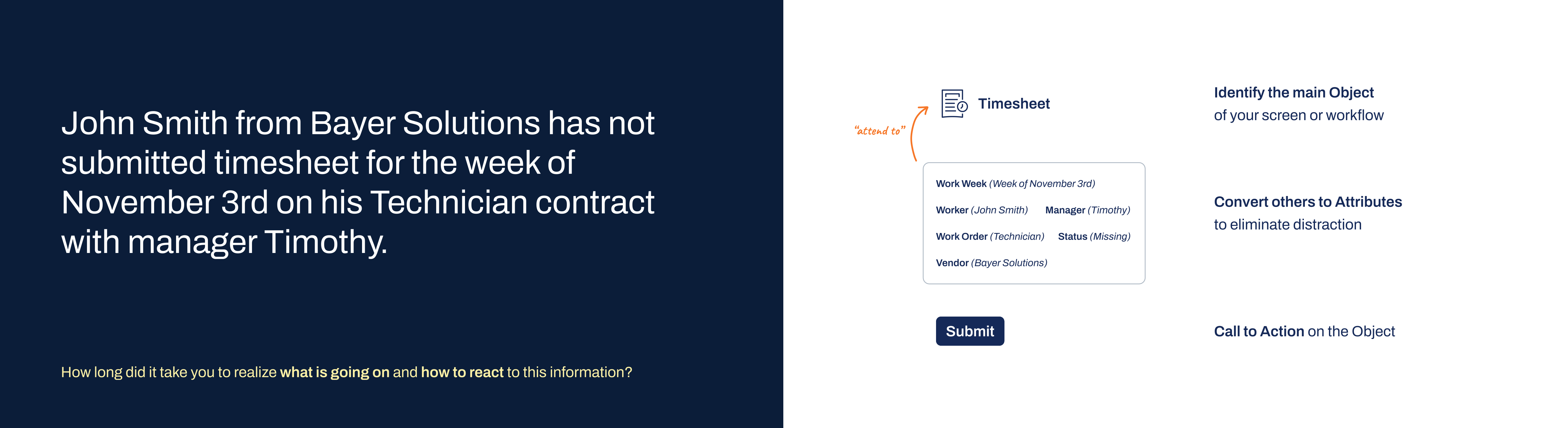
The Framework.
an effective experience, especially in the context of SaaS, is when plain information gets broken down into a clear architecture, guiding users what to look at (the object) & what to do about it (the action). instead of yelling at users, 'timesheet is missing!' or 'timesheet is overdue!' we'd better filtered the noise and guided users to submit it.
Execution
Solve The Systemic Homepage Platform Problem
In Q1 FY26, the Foundation team received inquiries from the GM to explain the current state of Homepage and a future vision to make the experience via homepage more actionable, and scalable for AI innovations. After sitting down with Product, these were the 3 execution objectives I set out as the starting point, emphasizing on understanding the problems before jumping into the redesign work.
Objectives
- Identify the value proposition of the homepage;
- Establish an experience strategy to bring a more insightful and actionable homepage to diverse user types.
- Explore potential AI-driven opportunities to provide a more efficient and curated user experience.
Main Challenge: Homepage had extremely high traffic, making the analytics data look “good” on paper, while both customers and users consistently provided negative sentiments. This contradiction created a deadlock: leadership saw no urgency for change, while cross-functional teams were misaligned on a path forward to address the underlying systemic frustration.
Key Insights
My apologies… This is a strategy-heavy UX work. I cannot share the details. But you can read my execution instead!
My Execution (that solved a 3-year long puzzle)
I treated my rotation across diverse product teams as a longitudinal study of the entire contingent program management lifecycle, allowing me to compile tactical research from many different initiatives and unlock deep historical knowledge. I was able to…
- pinpoint the “Moments that Matter” in different user journeys;
- prioritize key moments based on their systemic impacts rather than isolated pain points;
- ensure the design strategy addressed the customers’ program health as a whole.
When tasked with a redesign of the homepage, I took a calculated risk to shift the conversation from "visual polish" to "platform structure." Knowing when presenting to the Extended Leaders, I had to speak from a B2B perspective, which I didn’t have much experience with. Therefore, I took steps to…
- partner with an Outbound Product Manager to pressure-test customer expectations against current system capabilities;
- use the Object-Action framework to deconstruct the Homepage and compare it to customer sentiments, revealing the problem wasn't a UI failure, but a gap deep within the Tasks & Notifications system.
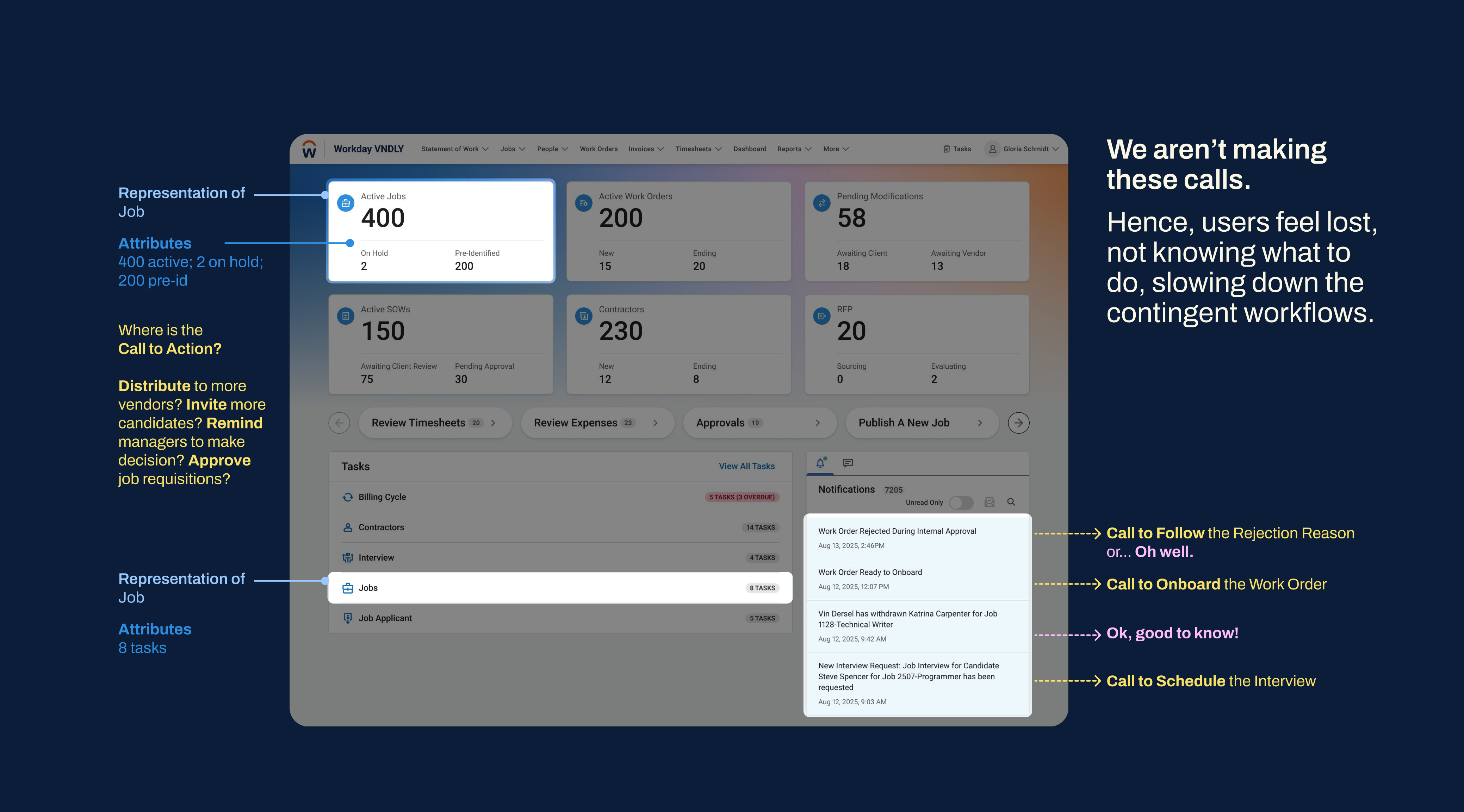
The X-Ray.
by running through the framework, the problem reveals itself, for flashy visuals can't hide the total lack of helpful insights or clear next steps. this visual is used to counter-argue the claim that the system already give customers what they had asked for—well... the features exist, but aren't good enough.
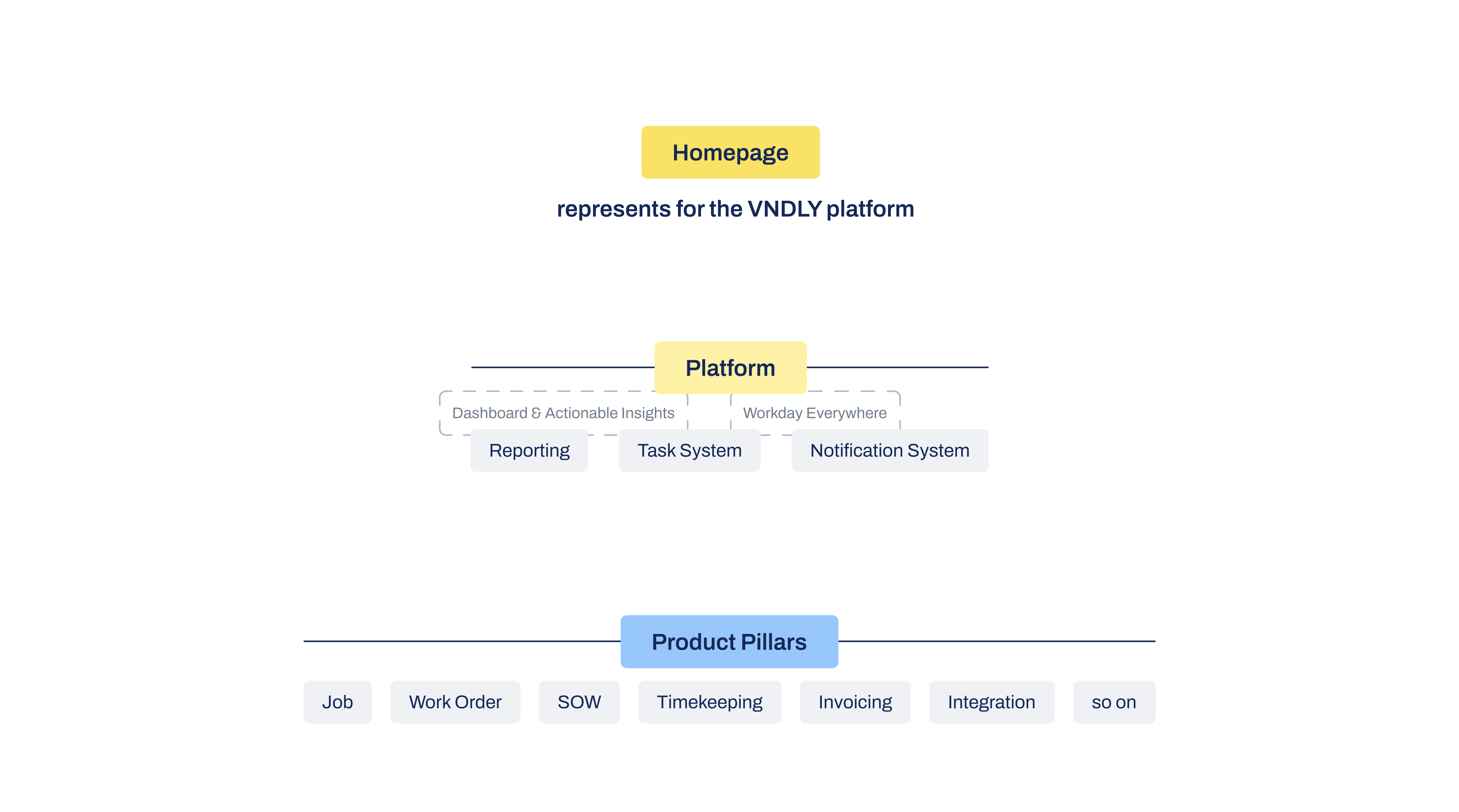
The Platform Structure.
real operation lies below the polished surface of the Homepage, within the Tasks and Notifications system, where information is processed and users only need to take action. without investment into the Platform layer, the software is nothing more than a nice data storage.
Impacts
- Influenced the Senior Leadership Team (SLT) to formally adopt “Tasks System Intelligence” as a FY27 Strategic Growth Initiative.
- Conceptualized a foundation to leverage the existing Tasks & Notifications frameworks to transform the VNDLY system from “a data storage” to an AI-powered service software, making the path to AI more tangible while unlocking user value in long term;
- Enabled the SLT to visualize the interconnectedness of platform-wide user pain points, ensuring investments made to solve the root causes effectively.
- Shifted the SLT’s perception to view UX Design as a strategic partner by demonstrating how UX artifacts can neutralize business problems with user needs and guide roadmap prioritization.
- Set a new benchmark for design communication by pioneering "no-mock" UX-Strategy presentations, focusing on logic, user flows, and systems thinking to drive more effective executive alignment.
Kudos:
Huge shoutout for such an outstanding and influential presentation this morning! You didn’t just bring your ideas, you brought sharp insights, thoughtful business connections and AI opportunities, solid data, and a perspective that reframed the real opportunity for improving the VNDLY experience. Rather than focusing only on giving the homepage a much-desired refresh, you guided the leadership to think bigger and address the underlying issues.
(UX Manager)
Thank you for all your contributions. This goes far beyond just helping with UI. You are a relentlessly curious person who finds a multitude of ways to add value: from product research and user research to user flow documentation and ideation sessions, etc. etc. Thank you Emi!
(Sr. Product Owner, Foundation)
You did such a fantastic job surfacing not only what wasn’t working with the current homepage but also a strong perspective on industry standards and a POV on what our users expect out of the homepage.
(Sr. Researcher)
Bring Semantic Interaction Design into Organization Practices
Goal: to bridge the gap between experience design and software development, providing a common language for designers and engineers to discuss usability problems as well as design decisions.
My Content Strategy
- Used algorithmic complexity as an analogy to cognitive load, that led to the Object-Action model.
- Curated a set of examples to cover 3 design levels: component, workflow, and platform; and 2 product pillars: Workforce & Pay.
Biggest challenge: to collect all those examples across the whole platform
I leveraged my experience working with many teams to set up scenarios and delegation accounts to collect all necessary examples. There were 10 in total, but I presented only 6 to maintain the audience's attention.
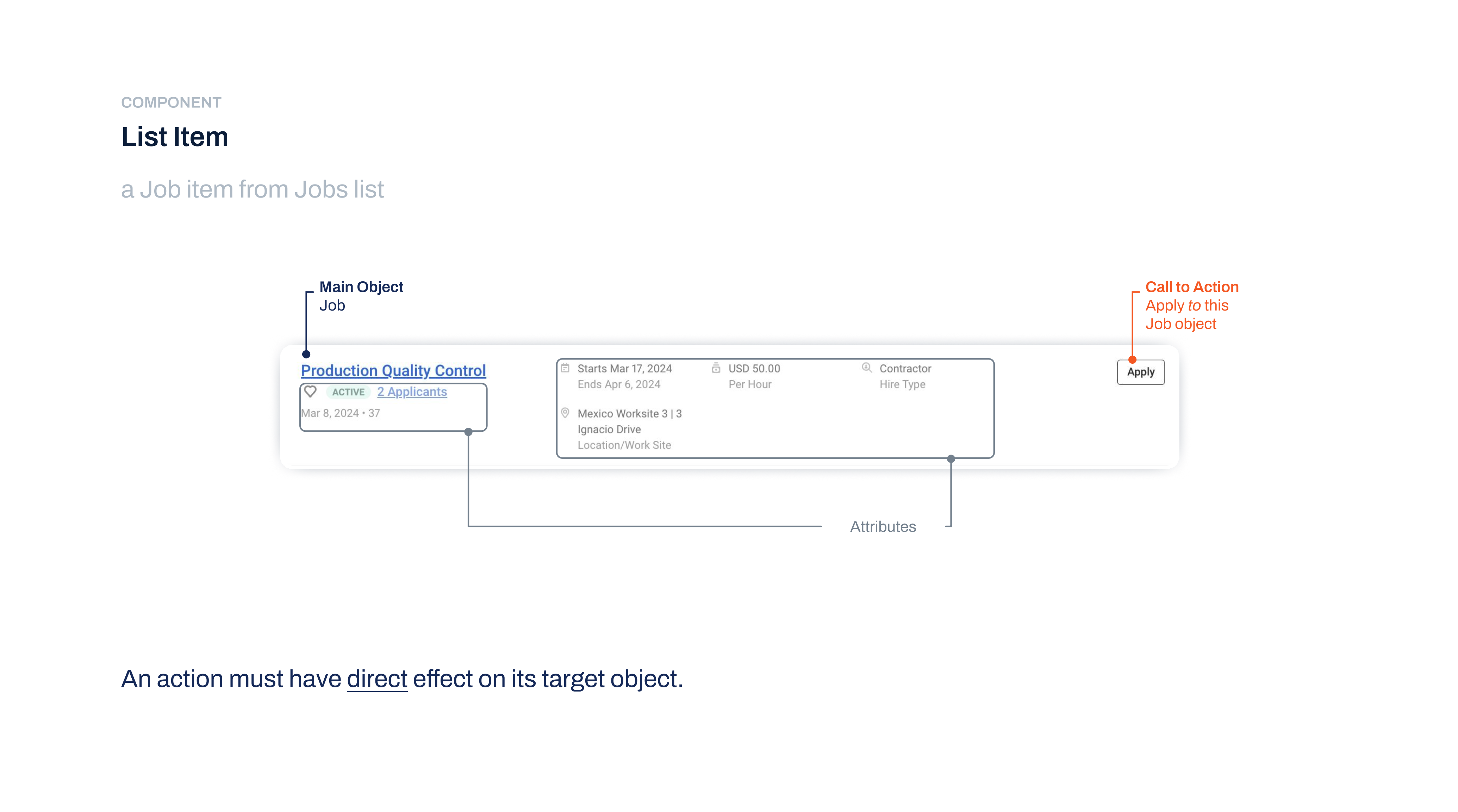
A Good List Item.
this layout treats Job Requisition as the main object. attributes like status and rates are organized to provide context without competing for attention, ensuring the user's focus remains on the Apply CTA. this is also a good CTA because it updates the applicants count of the Job object, until all positions are filled.
A Bad List Item.
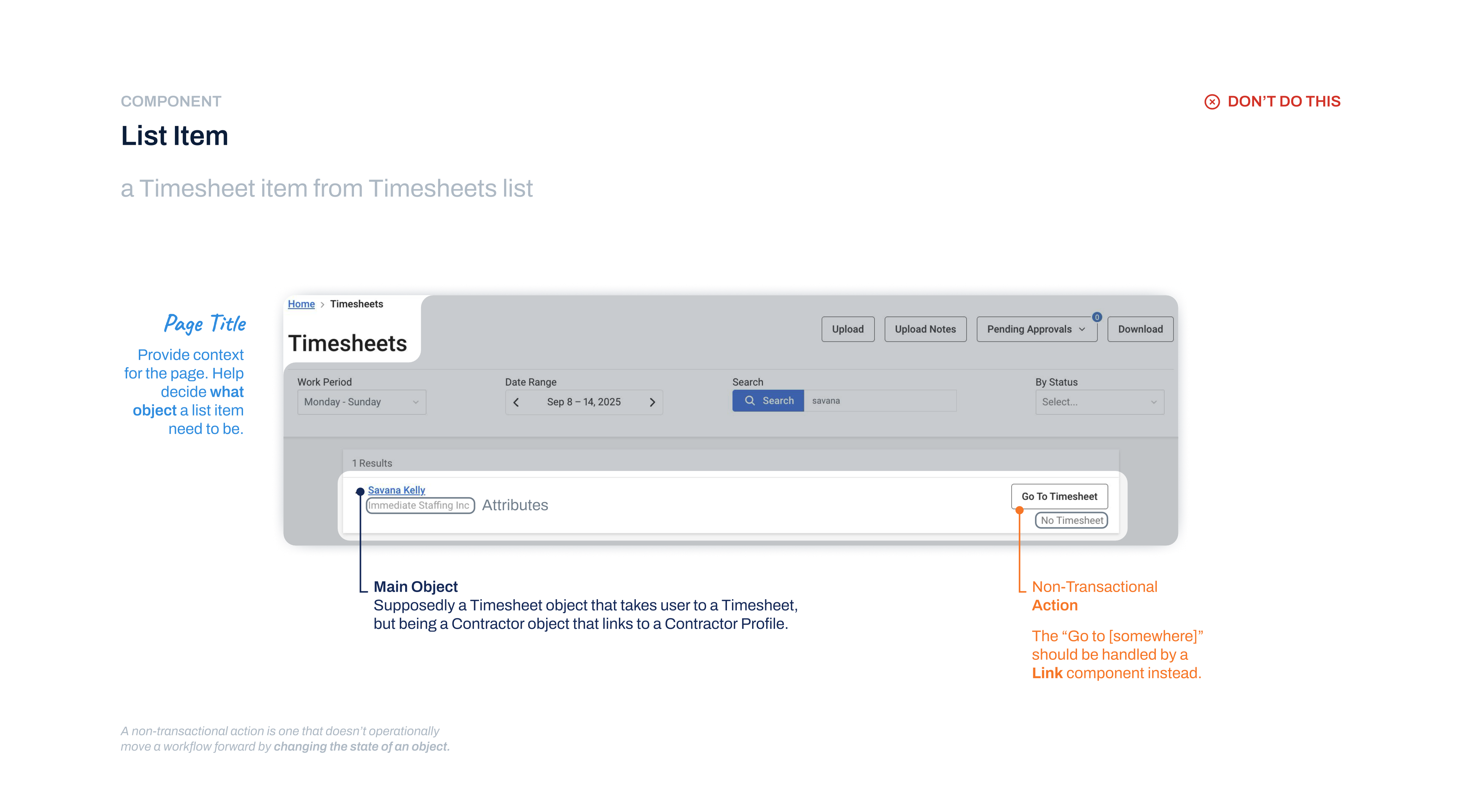
breaking down this Timesheet list item highlights the misalignment between visual hierarchy and system architecture. the primary object isn't linked to a timesheet but a contractor profile, and the CTA is used for navigation. a good CTA should be [Approve] / [Reject] because it is supposed to change the Timesheet object from "Pending" to the next status.
A Simple Task.
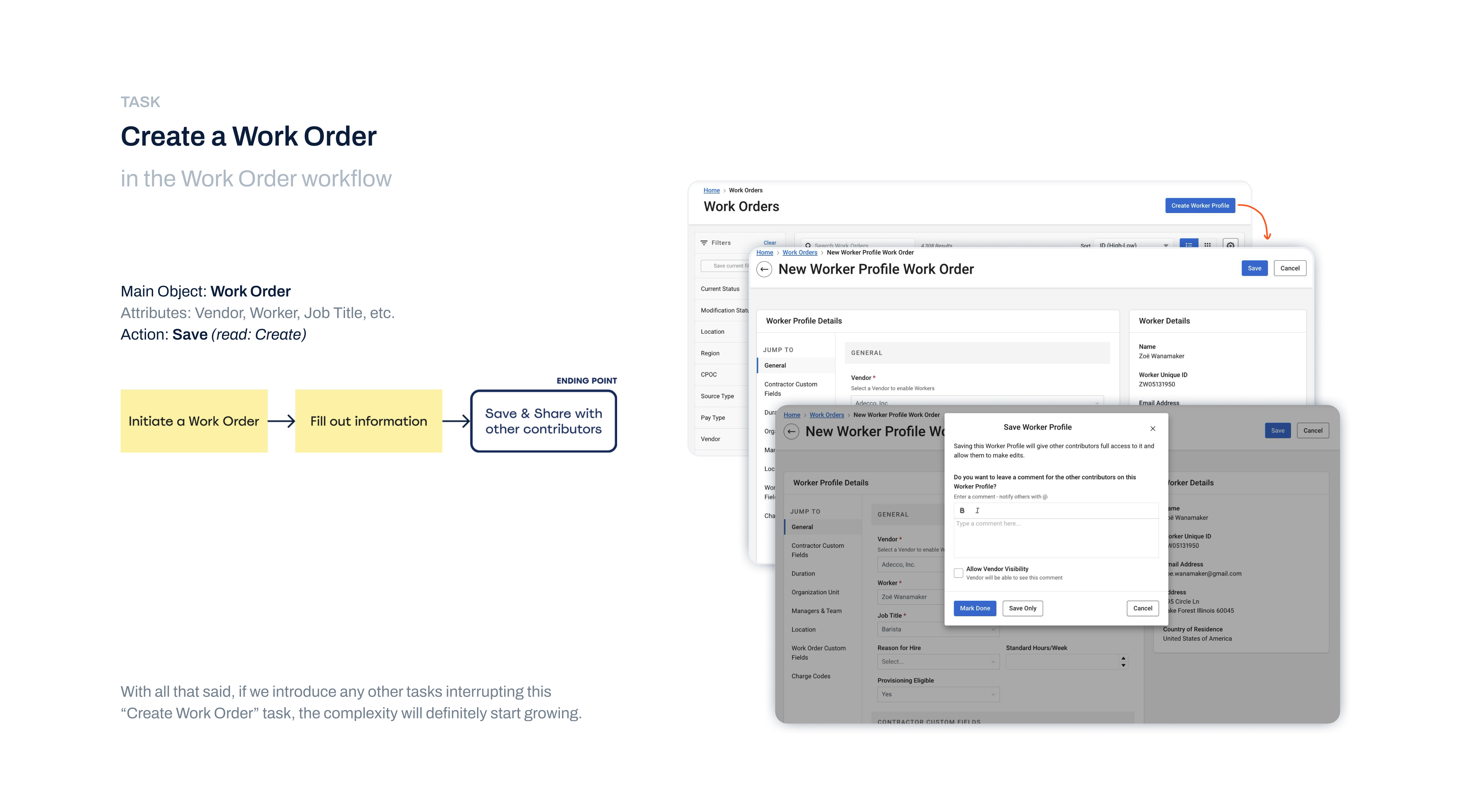
this flow focuses on the Work Order Creation journey, designed to be a singular, uninterrupted task. by handling complex validations in the background and excluding secondary tasks like Contractor Creation, the design ensures a frictionless experience that prioritizes clarity and efficiency.
A Centralized Work Order Architecture.
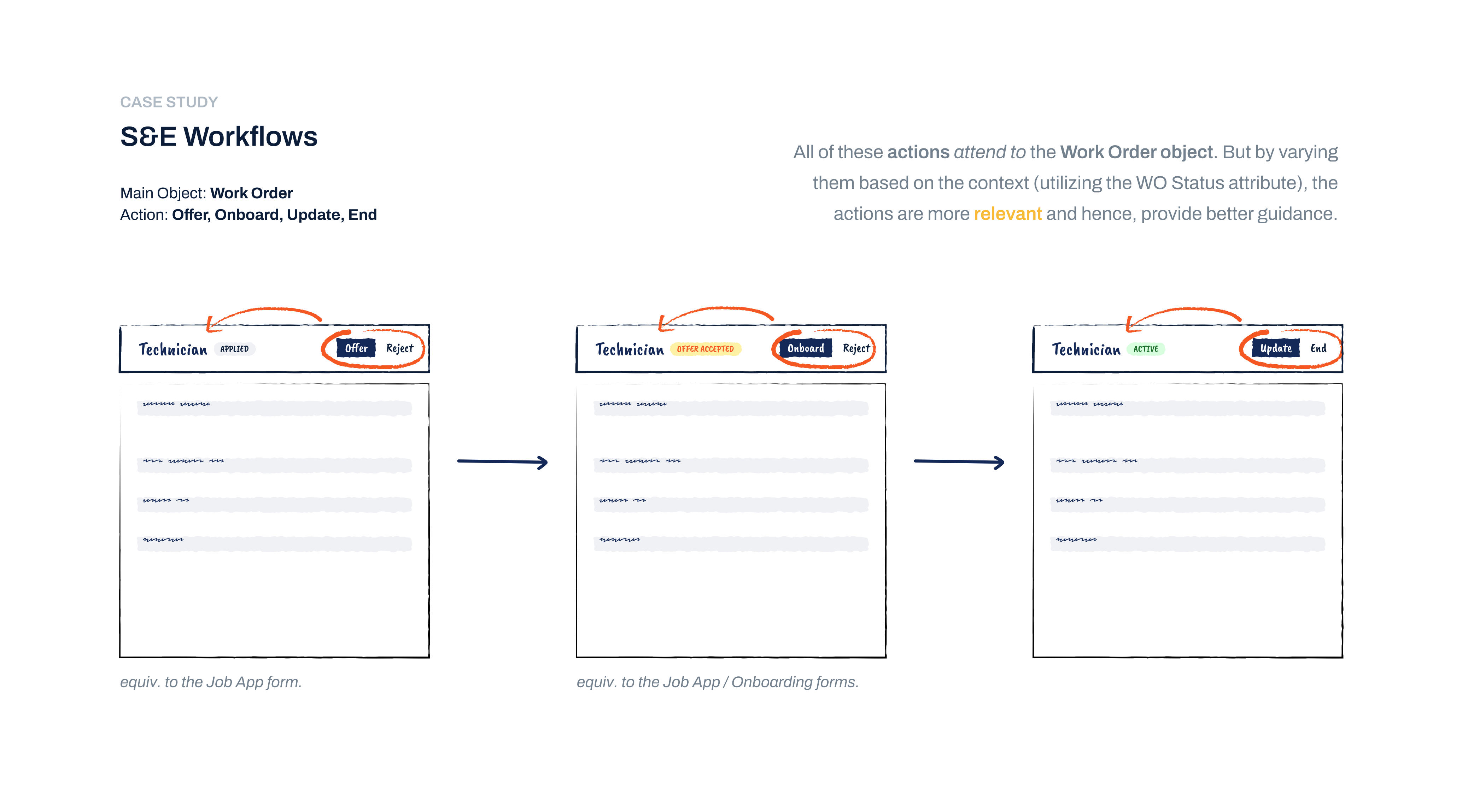
this "bonus track" conceptually explores how to improve an initiative previously struggled with user adoption. I proposed a dynamic UI that filters data attributes and CTAs based on status of the source pipeline. the approach balances technical consolidation and a task-oriented user experience.
Outcomes
- Eliminated misunderstandings and gained credibility from the most difficult teams and tech leads of the organization by aligning design approaches with system logics and use scenarios.
- Achieved 90% adoption of the framework in 3 cross-functional squads within Q4 FY26;
- Reduced up to 83% time spent on back-and-forth clarification meetings and mid-sprint revisions;
- Increased UX office hour sign-ups for topics on information architecture, over UI–polish;
- For my immediate team at the time, I was able to engage all stakeholder, tech leads, and engineers throughout the experience crafting process from the very early strategy phase.
- Raised the bar for UX design within the organization, influencing all designers regardless of seniority to adopt the Object-Action framework to justify design decisions rather than subjective preference.
- Reduced average design review time by 20 minutes by eliminating subjective debates and focusing on the interaction models.
Kudos:
Such a great presentation! Your ideas were well prepared and concise. You highlighted all the parts that I dislike the most in the app. Now I have better words to verbalize why I don’t like certain pages. And more importantly, the message was pretty clear and it will help us guide ourselves when we need to since we don’t always get to have one of the UX looking over our shoulder.
(Sr. SWE, Pay)
You did an amazing job on the presentation today! I really appreciate the time and care you took to craft a thoughtful message with many examples. I've definitely noticed how much you are leading through example.
(Principle SWE, Design System)
Awesome job presenting some alternative ways to explain design patterns and information architecture and interaction design. I’m so glad you put yourself and your ideas out there for Lunch & Learn!
(UX Manager)
Thank you for putting together such a thoughtful presentation.
(Sr. SWE, ML & AI)
I now see how UX and Engineering are very similar.
(Director of SWE, Workforce)
Learnings
This experimental, self-led initiative taught me that language is truly a powerful tool. It brings people together & guides decisions. By showing radical empathy for my cross-functional partners, I was able to transform notoriously difficult relationships into one of constructive collaboration and mutual respect.
Ultimately, this reinforced my belief that true innovation isn't a result of "creative flashes" but of a strong foundation grounded in systems science. Once the core language of a product is stabilized, the path to its next evolution is set clear.